


Your Child Has Something Money Can’t Buy: Time

At what age do you plan to introduce your child to investing?
We are introducing our child to investing by age 7.
Yes. Age 7.
Again, we are not planning to leave an inheritance for them, and if we do, we would wish it lands in prepared hands that can faithfully pass it on to their posterity.
By age 7, we plan to help them understand how money can grow by beginning to invest just a little money all the way to age 20, and leave it there to continue growing until they are in their 50s.
That would be enough and the best inheritance for them.
And remember, introducing your kid to investing is one thing. Helping them develop good money habits is another. Do not forget the latter.
THE MAGIC OF COMPOUND INTEREST
Here’s something every parent should know.
When money earns returns, and those returns begin earning returns of their own, something powerful happens. This is called compound interest.
Think of it like planting a tree.
At first, the growth is barely noticeable. You water it, protect it, and wait. But as the tree grows, its branches spread, and eventually it produces seeds that grow into more trees.
Money can work in a similar way.
The earlier you plant the seed, the more time it has to grow.
Let’s look at a simple example.
Suppose your child starts investing KSh 1,000 every month at age 18 and continues until age 60. Assuming an illustrative annual return of 8%, compounded monthly, they could accumulate approximately KSh 3.5 million.
They would have contributed KSh 504,000 of their own money. The rest would come from investment growth. Now, what if they started at 10?
Now imagine starting at 30 instead, investing the same KSh 1,000 every month under the same assumptions. By age 60, the investment could grow to approximately KSh 1.5 million.
That’s a difference of roughly KSh 2 million, simply because one person started 12 years earlier.
Also, check this other example in the picture:
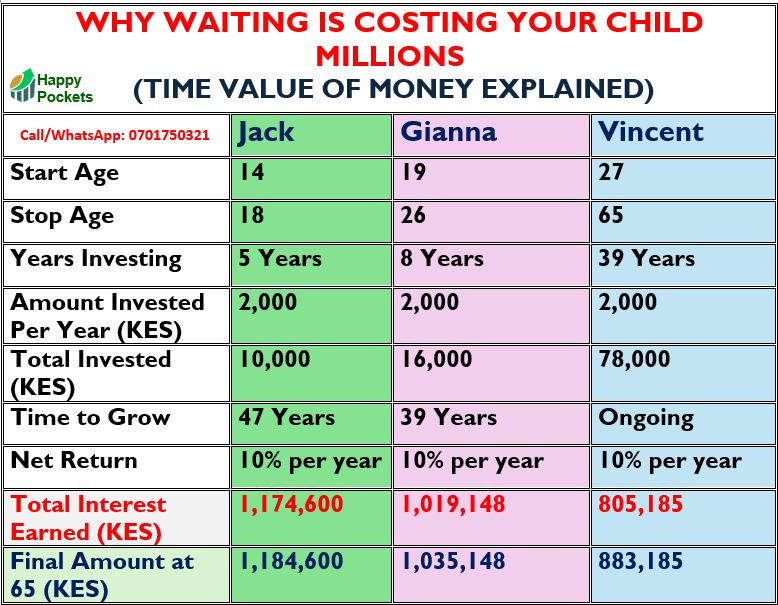
(These figures are illustrative, not guaranteed. Actual returns vary, and fees, taxes, inflation, and investment risk affect the outcome.)

You don’t need to be wealthy to begin. You don’t need complicated financial language, either.
Here are four simple ways to start:
1. Introduce the idea of growing money.
Explain the difference between saving money and investing it. Savings help with accessibility and short-term goals, while investing aims to grow wealth over time and involves risk. Help them understand that money can have different jobs.
2. Start small and make it tangible.
Use an age-appropriate savings or investment activity. If you offer a matching contribution or a small reward for saving, explain why you’re doing it. Let them watch their money grow and understand where the growth comes from.
3. Teach patience through everyday decisions.
When your child wants to spend all their pocket money immediately, don’t just say no. Ask, “If you save some of this today, what could it help you achieve later?” Help them connect today’s choices with tomorrow’s possibilities.
4. Let them observe your own money habits.
Children learn as much from what we do as from what we say. Talk openly about saving toward goals, planning for the future and making thoughtful financial decisions. You don’t have to share every financial detail; show them the principles in action.
MY FINAL THOUGHT
Dear parent, you may not be able to give your child a huge inheritance.
You may not be able to pay for every opportunity they will ever need.
But you can give them something incredibly valuable: an early understanding of how money grows, why patience matters, and how today’s decisions shape tomorrow’s possibilities.
You cannot give your child more time. But you can teach them how to use the time they have.
And that lesson could be worth more than the money you give them.
Your child’s financial journey begins in their early years. And the best place to start? Our upcoming Teen Finance Bootcamp.
Here, your teen will learn their money personality, how to begin managing their money, investments (bonds and mutual funds), and investing in the stock market as a teen.
Register your teen here: https://www.happypockets.co.ke/teen-finance-bootcamp
Let not your teen miss this. This will be practical and worth their precious time.
Until Next Week,
Happy Pockets Team
Discover more from Happy Pockets
Subscribe to get the latest posts sent to your email.