
The Measure of Economy’s Wellbeing: Gross Domestic Product (GDP)
How do you measure the size of an entire economy? Let’s say you buy a packet of milk for 60 Kenyan Shillings. Those 60 shillings are factored into the Kenyan Gross Domestic Product (GDP). The same applies to the machinery and equipment for processing the milk. Or, when you get a haircut, the service is also factored in our GDP. So, most of the things around you form part of our GDP. So, what do I mean? What is a GDP, or Gross Domestic Product?
GDP is an important measure of the economy’s overall health by determining the total value of goods and services in a country. So, it measures many things worth billions of money. The Kenyan GDP per year in 2024 was 503 billion dollars, while the United States and United Kingdom GDPs were 26.88 trillion dollars and 19 trillion dollars, respectively.
To find a country’s real GDP, we consider consumer spending (consumption), investments, government spending, and net exports.
How to Measure GDP
Gross Domestic Product (GDP) = Consumer Spending (Consumption) + Investments + Government Spending + Net Exports.
Consumer spending is the money you and I spend on the commodities and services we get, such as a purchase of sugar or a haircut. In developed countries, consumer spending makes up more than half of their country’s economy.
Investments, on the other hand, include how much businesses spend on things like buildings, land, machinery, and equipment. Major consumer investments, such as buying a house, also form part of investments. In many cases, when the economy is suffering, investments also suffer because many businesses would prefer saving their money rather than putting it in things like factories, machinery, and equipment.
Government spending is another huge percentage of the GDP. It is the money both national and state or county governments spend on public goods and services like building roads, schools, defense, healthcare, and so on.
Net exports are exports minus imports. When a country has negative net exports, it means that it is bringing in more products than it is sending out, and this might not be healthy for the economy because it kills local production. When the country records a positive net export, it simply means it is sending out more products than it is bringing in.
So, next time you see or hear of GDP, remember that it is a universal measure that countries use to determine the size of their economies.
GDP Growth Rate
What about the GDP Growth Rate? This is simply the percentage change of GDP over time. When the economy is perceived to be healthy, the GDP growth rate expands or is positive. A positive GDP growth rate means the economy is growing, businesses are producing more, people are spending more, and jobs are being created. However, when the economy is in bad shape, the GDP growth rate contracts or is negative.
A negative GDP growth rate means the economy is shrinking, businesses are producing less, people are spending less, and jobs are being lost. If the GDP growth rate is constantly negative for more than two quarters, it may lead the country into a recession. The GDP growth rate is normally reported every quarter, which means after every 3 months.
Kenya’s GDP Growth Rate in 2024
Let’s focus on the Kenyan GDP growth rate for the first three quarters, as released by the Kenya National Bureau of Statistics.
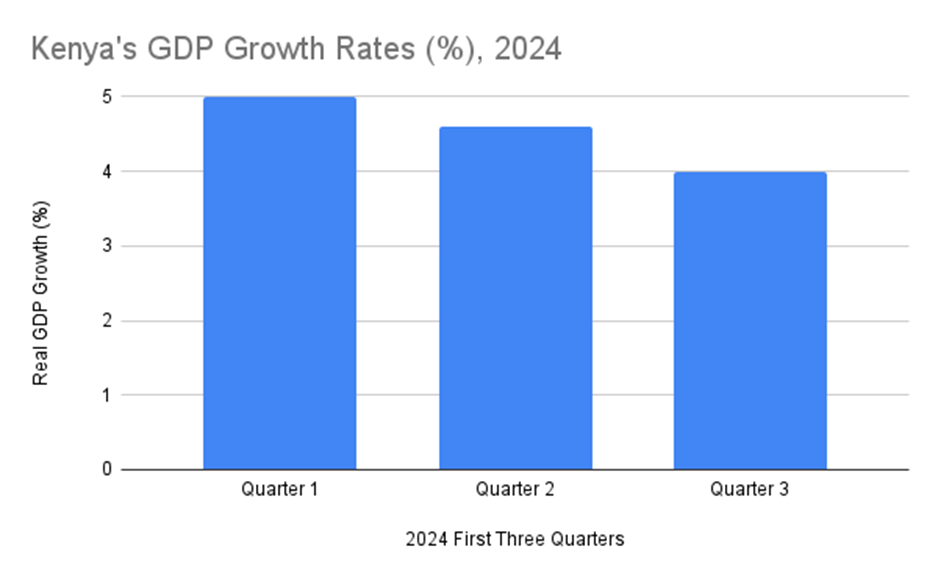
Figure 1: Kenya’s GDP Growth Rates (%) for the First Three Quarters 2024
From the above graph, Kenya’s GDP growth rate expanded by 5.0% in the first quarter. In the second quarter, it expanded by 4.6%, though it was lower than the first quarter. In the third quarter, it expanded by 4.0%, again lower than the second quarter.
What may be causing the GDP growth rate to decline? Many factors may contribute to this decline. For example, according to the Kenyan National Bureau of Statistics, the GDP growth rate of the second quarter declined because of a considerable reduction in some major economic activities such as agriculture, forestry and fishing, real estate, financial and insurance activities, and wholesale and retail.
So, when the GDP growth rate declines, it is mainly due to a general decline in growth in most sectors of the economy.
Conclusion
GDP is the best measure a country can use to measure its economic growth. It focuses on the citizens’ consumption (Consumer spending), investments, government spending, and net exports. However, economic experts have raised concerns that GDP does not fully measure the country’s economy because it leaves out some major sectors, like the digital economy.
Ever wondered if GDP reflects our overall happiness and quality of life? Well, that’s a topic we’ll delve into when we discuss inflation and its impact. Remember, the GDP growth rate is the percentage change of the GDP over a specific period. So, the next time you hear about your country’s GDP and GDP growth rate, you’ll be equipped to analyze the numbers with confidence, right?
Data Source:
Kenyan National Bureau of Statistics (KNBS) Quarterly GDP. https://www.knbs.or.ke/quarterly-gdp/.
Discover more from Happy Pockets
Subscribe to get the latest posts sent to your email.